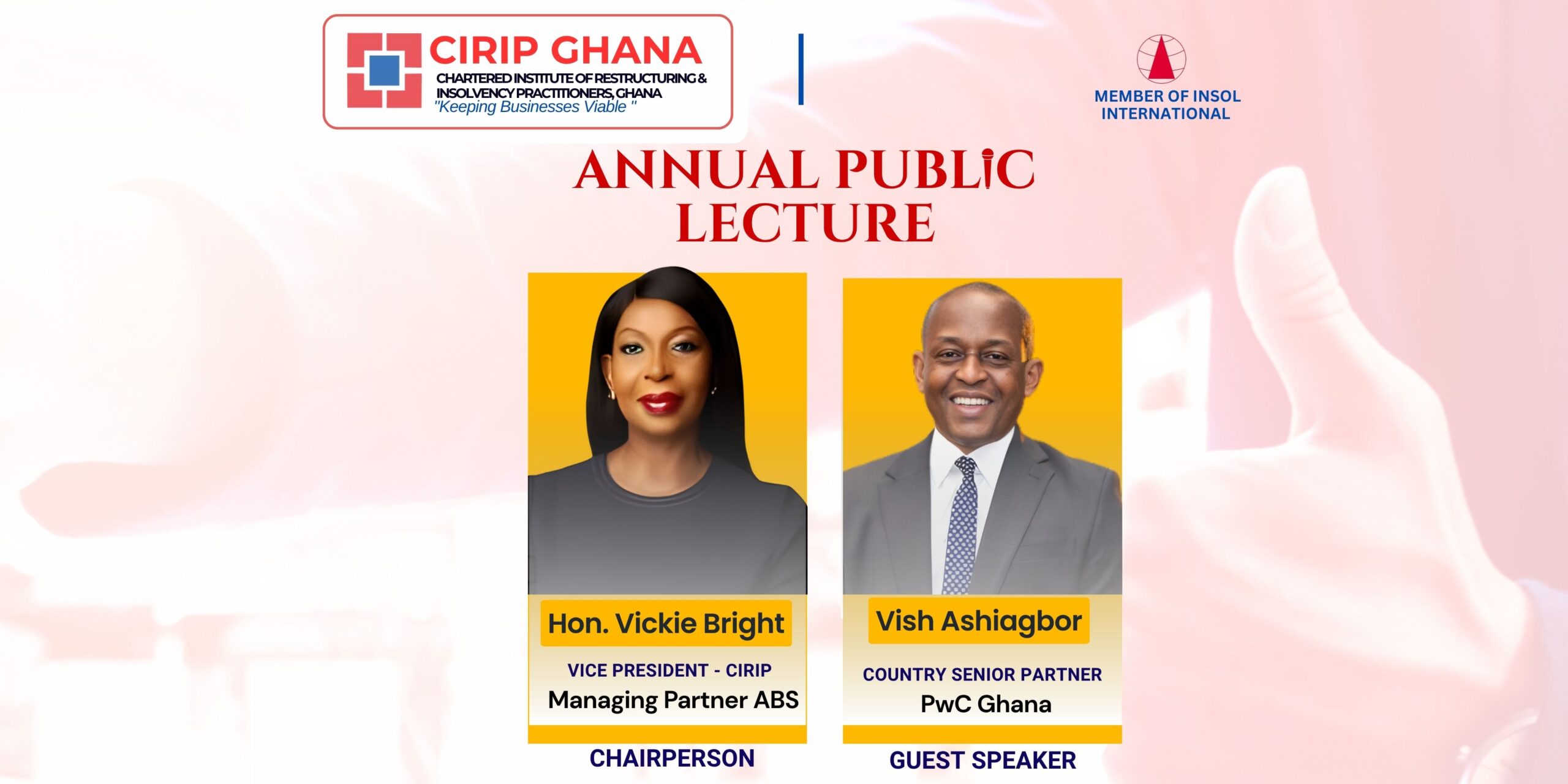
The Chartered Institute of Restructuring and Insolvency Practitioners (CIRIP) Ghana successfully held its first Public Lecture of the year on Wednesday, 26 February 2026, under the theme “Navigating the Protocols and Practice of Restructuring & Insolvency.” The virtual event, hosted on Microsoft Teams, attracted approximately 111 participants drawn from across Ghana’s legal, financial, regulatory, and corporate governance ecosystem.
Participants included insolvency practitioners, lawyers, accountants, bankers, regulators, corporate executives, students, and other key stakeholders with an interest in restructuring and insolvency practice. The strong turnout underscored growing interest in Ghana’s evolving business recovery framework and the relevance of insolvency practice in the current economic climate.
The lecture formed part of CIRIP’s ongoing commitment to professional education, capacity building, and thought leadership following its transition into a statutory professional body under the CIRIP Act, 2024 (Act 1117).
Opening and Welcome
Participants began joining the virtual platform from 2:45 PM, with the programme commencing promptly at 3:00 PM. The session opened with a prayer led by Mr. Theophilus Aryee, Chief Risk Officer of GCB Bank, who set a reflective and purposeful tone for the engagement.
Delivering the welcome remarks, Mr. George N. Owodo, Chief Executive Officer of CIRIP Ghana, expressed appreciation to participants for the strong attendance. He highlighted CIRIP’s renewed mandate as a statutory institute and reaffirmed the Institute’s focus on strengthening professional standards through continuous learning and stakeholder engagement.
Mr. Owodo emphasised that restructuring and insolvency practice sits at the intersection of law, finance, governance, and economic policy. He noted that as corporate distress situations become more complex, practitioners must be well‑equipped not only with technical knowledge but also with a clear understanding of procedural and practical realities. He described the theme of the lecture as timely and relevant to current market conditions.
He then introduced the Chairperson for the event, Hon. Vickie Bright, Vice President of CIRIP Ghana.
Chairperson’s Remarks and Introduction of the Speaker
In her opening remarks, Hon. Vickie Bright spoke to the growing importance of restructuring and insolvency practice in Ghana’s economy. She emphasised that modern insolvency practice goes beyond liquidation and plays a vital role in preserving enterprise value, sustaining jobs, and supporting financial stability where companies remain viable.
She also reminded participants of the responsibility placed on insolvency practitioners to uphold the highest standards of professionalism, ethical discipline, and procedural rigour. She encouraged active participation throughout the session, noting that professional dialogue and shared learning are essential to strengthening Ghana’s insolvency ecosystem.
Hon. Bright then introduced the Keynote Speaker, Mr. Vish Ashiagbor, Country Senior Partner of PwC Ghana. She highlighted his extensive leadership experience, professional expertise, and deep involvement in restructuring and insolvency engagements, describing him as well‑positioned to provide both technical and practical insights on the subject.
Keynote Lecture: Practical Insight Meets Legal Protocol
In his keynote address, Mr. Vish Ashiagbor provided a comprehensive and engaging presentation that combined legal analysis with real‑world experience.
He began by situating the discussion within Ghana’s legal and institutional framework, particularly the Corporate Insolvency and Restructuring Act, 2020 (Act 1015). He emphasised that the spirit of the law prioritises business rescue where viable, and orderly exit where recovery is not feasible.
A major focus of the presentation was the importance of established protocols in insolvency and restructuring practice. Mr. Ashiagbor stressed that strict adherence to statutory timelines, transparent communication with creditors, proper documentation, and disciplined engagement with regulators and the courts are essential to successful outcomes.
Drawing from practical experience, he discussed common challenges faced by practitioners, including resistance from distressed company management, complex creditor dynamics, funding constraints during administration, court delays, and limited stakeholder understanding of restructuring tools. He encouraged practitioners to balance technical compliance with commercial awareness and strategic judgment.
Mr. Ashiagbor also highlighted the ethical responsibilities of insolvency practitioners, noting that independence, transparency, and fairness are critical to maintaining public confidence in the profession. Throughout the lecture, he used practical illustrations that resonated with participants and brought theory into real‑life context.
Interactive Q&A Session
The lecture was followed by a robust Question and Answer session, moderated by the Chairperson. Participants engaged actively with questions on the interpretation of Act 1015, the role of secured creditors, managing competing stakeholder interests, court processes, and practical negotiation strategies.
The depth and quality of the discussion reflected the strong interest among participants and reinforced the need for continuous professional dialogue in the insolvency space.
Closing and Outlook
In her closing remarks, Hon. Vickie Bright thanked the Speaker for his insightful presentation and commended participants for their active engagement. She reaffirmed CIRIP’s commitment to providing platforms that enhance professional competence and promote best practice.
The CEO later made brief announcements regarding upcoming CIRIP programmes, encouraging members to participate actively and support the Institute’s work.
Conclusion
The public lecture was a resounding success, delivering both technical guidance and practical insight to a diverse audience. The strong turnout and active participation reaffirm CIRIP’s role as a leading platform for professional development and thought leadership in restructuring and insolvency.
CIRIP Ghana remains committed to organising high‑quality engagements that support professional excellence, strengthen business recovery practice, and contribute to the development of Ghana’s corporate governance and insolvency framework.